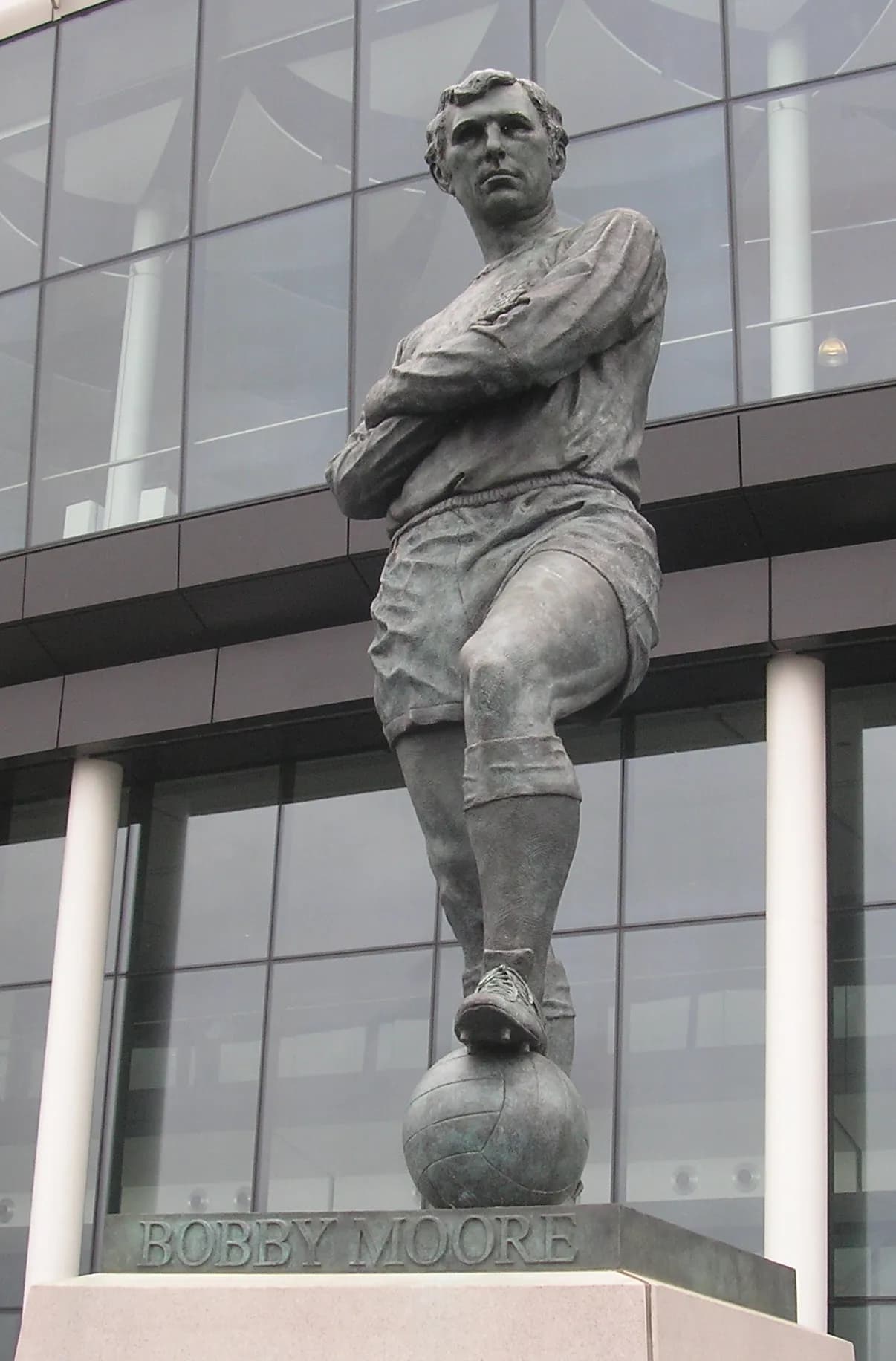
The Boy From Barking Who Became a National Hero
Robert Frederick Chelsea Moore was born on 12 April 1941 at Upney Hospital in Barking, Essex. The son of Robert E. Moore and Doris (née Buckle), he spent his formative years at 43 Waverley Gardens, a modest semi-detached house that still stands today in the heart of Barking.
Early Life in Barking
Moore attended Westbury Primary School in Barking, where he first developed his love for football. His education continued at Tom Hood School in nearby Leytonstone, but it was Barking that shaped his early years. The postwar East End provided the backdrop for a childhood that would culminate in sporting immortality.
In 1956, at the age of 15, Moore joined West Ham United's youth setup. He made his first-team debut on 8 September 1958 against Manchester United, beginning a career that would span nearly two decades and cement his status as one of England's greatest ever footballers.
The Road to 1966
Moore earned his first England cap on 20 May 1962 against Peru, a late call-up for the World Cup in Chile. At just 22 years old, he was appointed England captain in 1963; the youngest man to hold the armband at that time.
The 1966 World Cup transformed Moore from a talented defender into a national icon. As captain, he led England through the tournament with composure and tactical intelligence that belied his youth. The final against West Germany at Wembley on 30 July 1966 remains the defining moment of English football history. Moore's team defeated the Germans 4–2 after extra time, with Geoff Hurst scoring a hat-trick.
The image of Moore wiping his hands on his shirt before shaking hands with Queen Elizabeth II to receive the Jules Rimet Trophy has become one of the most enduring photographs in British sporting history. That moment of quiet dignity, captured on the pitch at Wembley, encapsulated the character of the man from Barking.
Club Career and Achievements
Moore's loyalty to West Ham United defined his club career. He made 544 league appearances for the Hammers, scoring 24 goals. During his time at Upton Park, he won the FA Cup in 1964 and the European Cup Winners' Cup in 1965. These victories established West Ham as a force in English and European football.
On 14 February 1973, Moore won his 100th England cap in a match against Scotland at Hampden Park. He finished his international career with 108 caps, a record at the time of his retirement in 1973. He remains the only England captain to have lifted the World Cup.
Moore's contributions to English football were recognised with an OBE in the 1967 New Year Honours. He was also named BBC Sports Personality of the Year in 1966, becoming the first footballer to win the award.
Remembering Barking's Most Famous Son
Barking has not forgotten its most celebrated resident. In 2008, the London Borough of Barking and Dagenham Council commissioned the "Sporting Heroes of Barking and Dagenham" sculpture on Gale Street. This striking corten steel artwork depicts four figures: Bobby Moore, Sir Alf Ramsey (who was born in Dagenham and managed England to World Cup victory), rugby World Cup winner Jason Leonard, and Paralympic athlete Beverley Gull.
The sculpture ensures that Moore's connection to Barking is permanently enshrined in the borough's public spaces. Unlike the more famous 20-foot bronze statue of Moore that stands outside Wembley Stadium; unveiled in 2007 and inscribed with the words "Favourite son of London's East End" — the Gale Street tribute places Moore firmly within his home community.
The World Cup Sculpture, known as "The Champions," stands at the junction of Barking Road and Green Street near the former Boleyn Ground. This bronze statue shows Moore being held aloft by teammates Geoff Hurst, Martin Peters, and Ray Wilson, holding the Jules Rimet Trophy. Commissioned by Newham Council and West Ham United in 2003, it celebrates the club's contribution to England's 1966 triumph.
A Lasting Legacy
Moore died on 24 February 1993 in Putney, London, aged just 51. His passing prompted an outpouring of national grief, with tributes flowing from across the football world and beyond. He is buried in Putney Vale Cemetery.
Today, Moore remains the standard against which all English defenders are measured. His reading of the game, technical ability on the ball, and leadership qualities set him apart from his contemporaries. Franz Beckenbauer, the legendary German defender, described Moore as "the greatest defender I have ever seen."
For the people of Barking, Moore represents something more than sporting excellence. He is proof that talent and determination can elevate a local boy to the pinnacle of global achievement. His childhood home at 43 Waverley Gardens stands as a tangible connection to the man who, on a summer's day in 1966, held the World Cup aloft and etched Barking's name into footballing folklore.
A Source of Local Pride
Moore's connection to Barking continues to inspire young footballers in the borough. His story is taught in local schools, his image adorns community spaces, and his legacy informs the area's sporting identity. When England teams take the field at Wembley, they pass beneath the gaze of Moore's statue; a reminder of what is possible for those who come from this corner of East London.
Barking has produced other notable sportsmen, including former England and Chelsea captain John Terry, and rugby union World Cup winner Jason Leonard. Yet Moore remains the borough's most famous son, his name synonymous with the greatest achievement in English football history.
As the nation continues to chase the dream of recapturing 1966's glory, Barking can claim a unique place in that story. The captain who led England to the summit was born in Upney, raised in Waverley Gardens, and educated in local schools. Bobby Moore was, and remains, one of Barking's own.