Barking Abbey, founded in the seventh century, stood for nearly 900 years as one of the most important religious houses in England, ruled over by a line of formidable abbesses who shaped the town’s identity long before the Industrial Revolution arrived on the River Roding.
Foundation and Early Years
The abbey was founded around 666 AD by Saint Erkenwald, a royal prince who later became Bishop of London, for his sister Saint Ethelburga. It was established as a double monastery, housing both nuns and monks, and was dedicated to the Virgin Mary before later being jointly dedicated to St Mary and St Ethelburga. The original buildings were constructed from wood, wattle and daub, and reused Roman tiles, reflecting the site’s continuity from the Roman period.
A Centre of Learning and Influence
Under Saint Hildelith, who succeeded Ethelburga and served as abbess until around 712 AD, Barking Abbey became a recognised centre of learning. The nuns of the community were the dedicatees of Aldhelm’s De Virginitate, written around 700 AD. The abbey’s reputation extended across the continent. Correspondence between the abbess and Saint Boniface, the missionary to Germany, survives from the eighth century.
The abbess of Barking held precedence over all other abbesses in England and was one of only four required to perform military service to the Crown, a mark of the house’s national standing.
Royal Connections and Political Power
Barking’s abbesses moved in the highest circles of medieval power. Saint Wulfhilda became abbess around 963 AD and was briefly deposed by Queen Ælfthryth before being reinstated by King Æthelred the Unready. In 1173, Mary Becket, sister of Saint Thomas Becket, was appointed abbess as an act of reparation by Henry II for Becket’s murder.
Katherine de la Pole, abbess from 1433 to 1473 and daughter of the 2nd Earl of Suffolk, hosted Edmund and Jasper Tudor at the abbey, where they were raised and educated. This connection placed Barking at the heart of the dynasty that would go on to found the Tudor royal line.
After the Norman Conquest, William the Conqueror stayed at Barking Abbey while the Tower of London was under construction and received the submissions of Morcar and Edwin, the Earls of Northumbria and Mercia, at the abbey site.
Wealth and Setback
In 1291 the abbey’s income was recorded as £300 13s 1¼d. By 1535 its gross income had risen to £1,084 6s 2¼d, making it the third wealthiest nunnery in England. The community’s lands stretched across Essex and into London, with the abbey holding significant property on the Thames foreshore.
The abbey suffered a catastrophic blow in 1377 when a large portion of its lands near the River Thames were flooded, severely damaging its finances. The community never fully recovered from the loss.
Earlier, around 871 AD, the abbey was burned by Viking raiders, forcing the nuns to flee to their London estate. It was refounded as a female-only community in the early to mid-tenth century.
Dissolution and Destruction
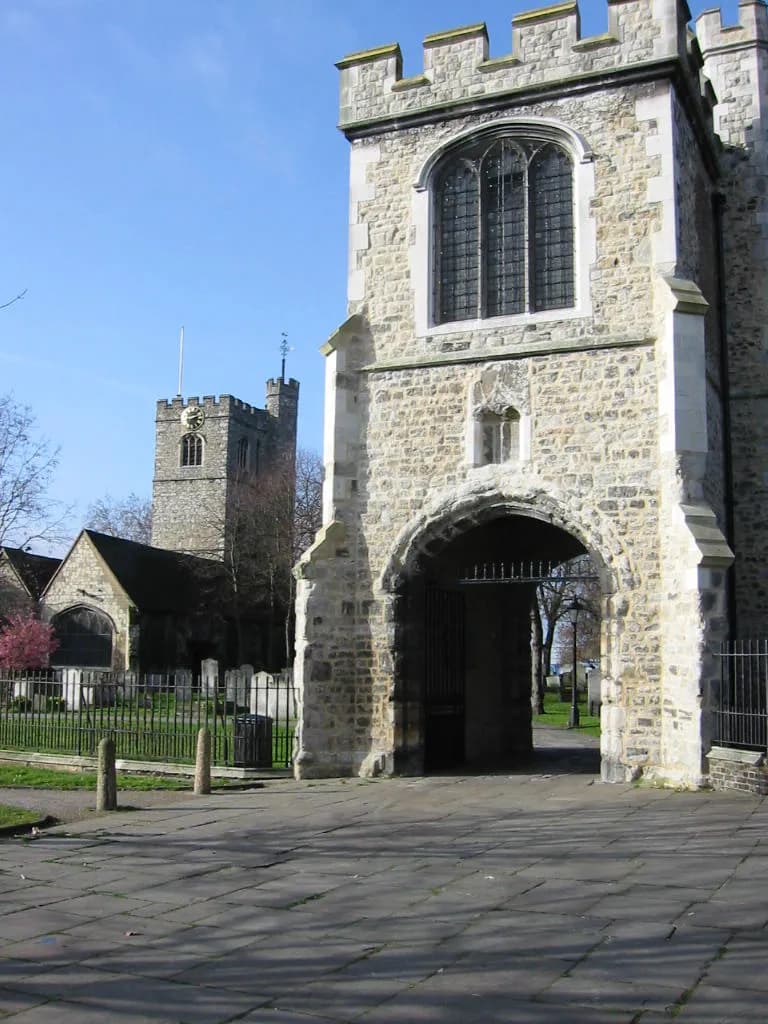
The end came in 1539 as part of Henry VIII’s Dissolution of the Monasteries. The abbey was formally surrendered by the abbess and 30 nuns on 14 November 1539. Demolition began in June 1540 and took approximately 18 months. Almost everything was reduced to rubble, with only the north gate, later known as the Curfew Tower, left standing.
What Remains in Barking Today
The ruined footprint of the abbey now forms Abbey Green, a public open space managed by Barking and Dagenham Council. The Curfew Tower, also known as the Fire Bell Gate, is a Grade II* listed structure and the only substantial surviving building from the abbey complex. The original tower was built in 1370, with the current structure dating to around 1460. Above the gateway is the Chapel of the Holy Rood.
The tower appears on the coat of arms of the London Borough of Barking and Dagenham, a reminder of the institution that gave the town its medieval prominence. Adjacent to the abbey site stands St Margaret’s Church, a Grade I listed building dating to the 13th century, which was built within the abbey grounds and remains an active place of worship.
Excavations in 1910 and 1911 revealed the abbey’s layout, and visible structural outlines were later marked out on the ground to help visitors understand the scale of what was once one of the most important religious houses in medieval England.